Resin injection cost: is there an alternative?
September 7, 2026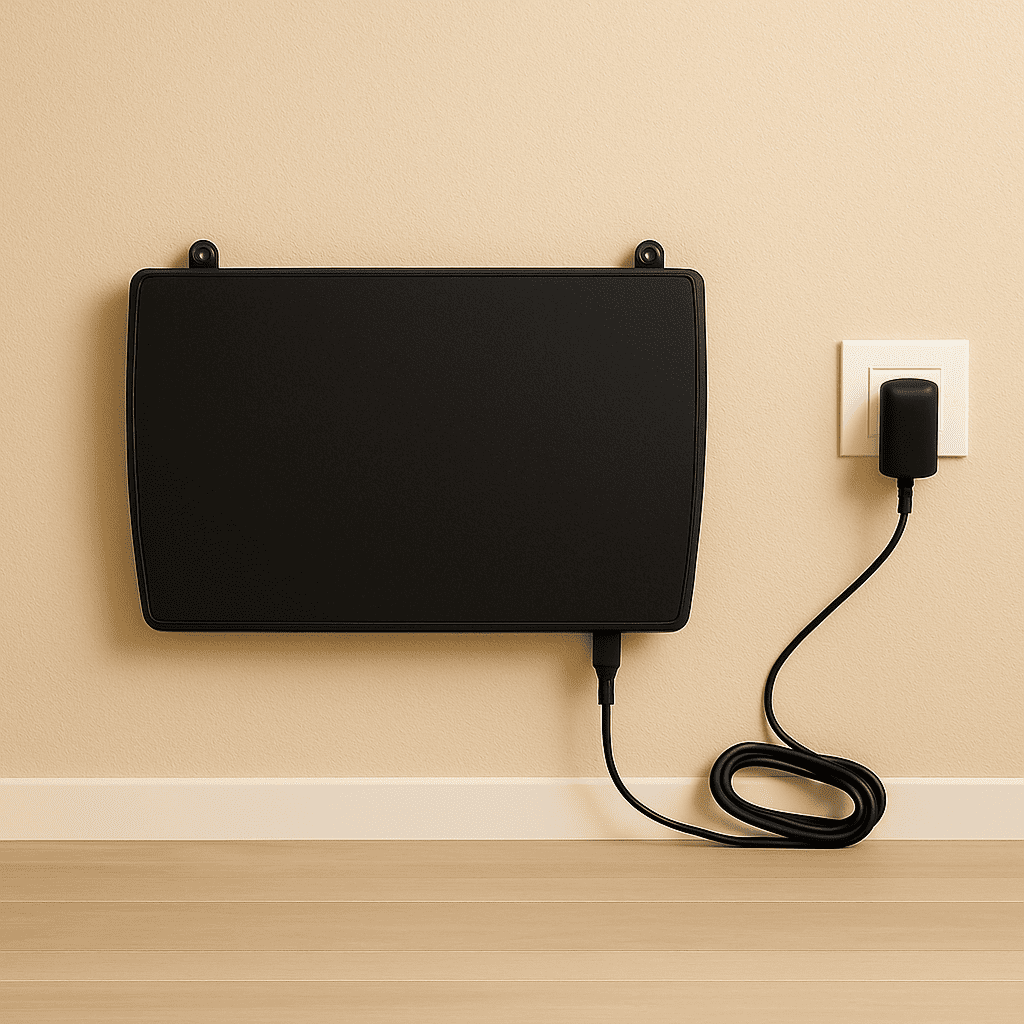
A damp party wall creates a particular problem. The wall belongs to two homes, yet water ignores property boundaries entirely. So here is how to identify the source, what falls on each side, and how to treat the wall without turning the matter into a dispute.
Why a damp party wall behaves differently
One wall, two occupants
The wall is single, but each household sees only one face. Consequently, a mark that appears in your home may well originate next door. And the reverse holds just as often.
A wall with no openings
A party wall rarely contains windows. Therefore it receives little sunlight, and air moves past it slowly. Surface evaporation slows down as a result.
A load-bearing wall, so it meets the ground
Most party walls carry load. They therefore sit on the footings. Yet many have no damp proof course at their base. Ground water climbs through them by capillary action, exactly as in any load-bearing wall.
Two households, two indoor climates
Your neighbour may heat less, or ventilate differently. In this way, one wall faces two sets of conditions. That temperature gap encourages condensation on the colder side.
Damp party wall: identify the source first
Three causes leave similar marks. However, they call for different work and different people.
Rising damp
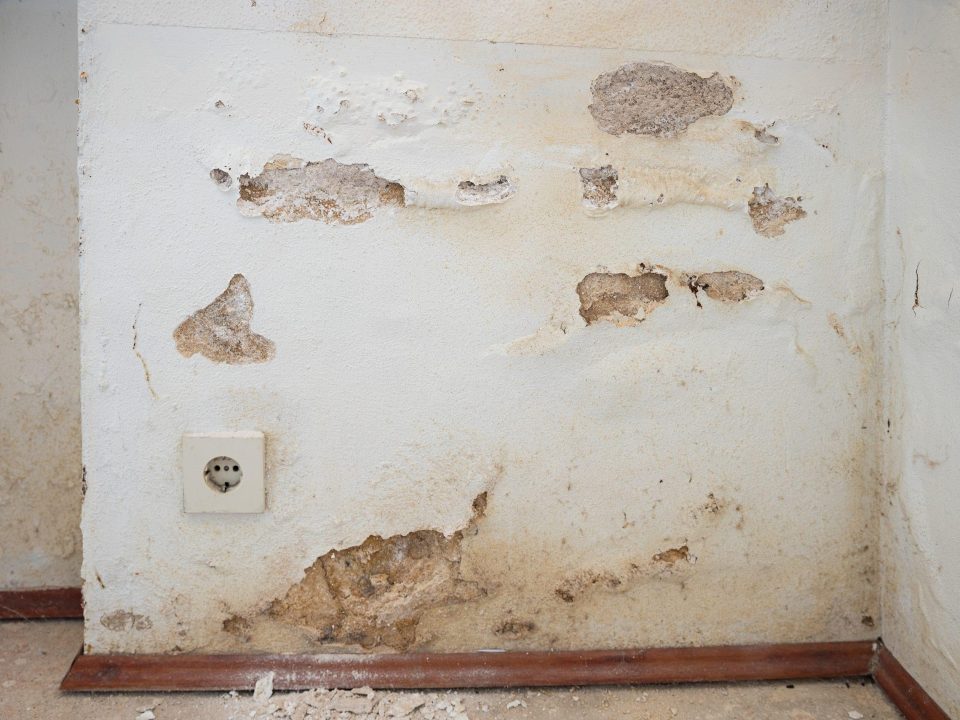
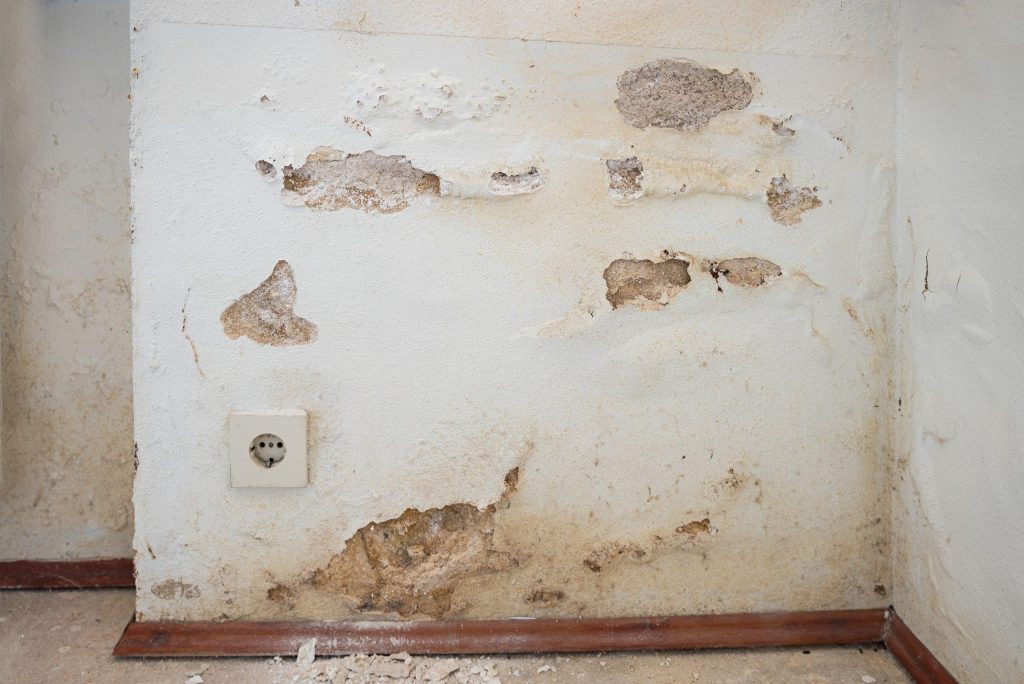
It draws a continuous band along the base of the wall, at fairly even height. Moreover, it advances slowly over months, with no link to rainfall. White deposits often accompany it. Our page on rising damp and saltpetre sets out every sign.
Penetrating damp
It produces an isolated, sharp patch. It appears quickly and follows rainfall. On a party wall, look at the roof junction, a failed flashing or a downpipe. See our page on floods and water damage.
Condensation
It leaves black mould in corners and behind furniture. It worsens in winter and eases in summer. See our page on wall condensation.
Damp party wall: four checks that settle it
Shape and height
Measure the upper edge at three points. An even height points to the ground. By contrast, a round isolated patch points to a single entry point.
The neighbouring face
Ask your neighbour whether they see the same thing. This check decides the most, and it costs nothing. A mark on both faces at similar height means water sits inside the thickness of the wall.
The seasonal rhythm
Note whether the problem follows rain, follows winter, or follows nothing. Slow steady progress does not come from the air.
The base of the wall outside
Walk around the building on a wet day. Check gutters, downpipes, gullies and the slope of the ground. Paving laid tight against the façade extends contact with wet soil.
What falls to whom
This question arrives quickly, and it deserves a calm answer.
Rising damp affects the wall itself, therefore both sides. In practice, a treatment fitted on one face acts through the full thickness, since the masonry is shared.
Penetrating damp comes from one precise defect. It therefore falls to whoever owns that defect: roof, flashing, downpipe or pipework.
Condensation depends on how each home is used and ventilated. Each household then acts on its own side.
The most effective approach is to establish the cause before opening the discussion. Indeed, disagreements rarely concern clear facts. They concern assumptions.
Treating a damp party wall fed by the ground
Resin injection
It creates a horizontal barrier inside the wall. However, it assumes clear access along the full length, which is often missing on one side. Furthermore, the work stays permanent.
A physical damp proof course
A saw cuts the wall section by section. Yet this is a shared load-bearing wall. The work therefore becomes heavy and hard to agree on.
Perimeter drainage
It carries water away from the footings. However, a party wall is rarely accessible from outside along its whole length.
Polarity inversion
This approach acts on how water behaves rather than on the structure. Water molecules carry two opposite charges, which helps them climb through the capillaries. A unit emits a low-frequency signal that disturbs that balance. Consequently, the water moves back down towards the ground.
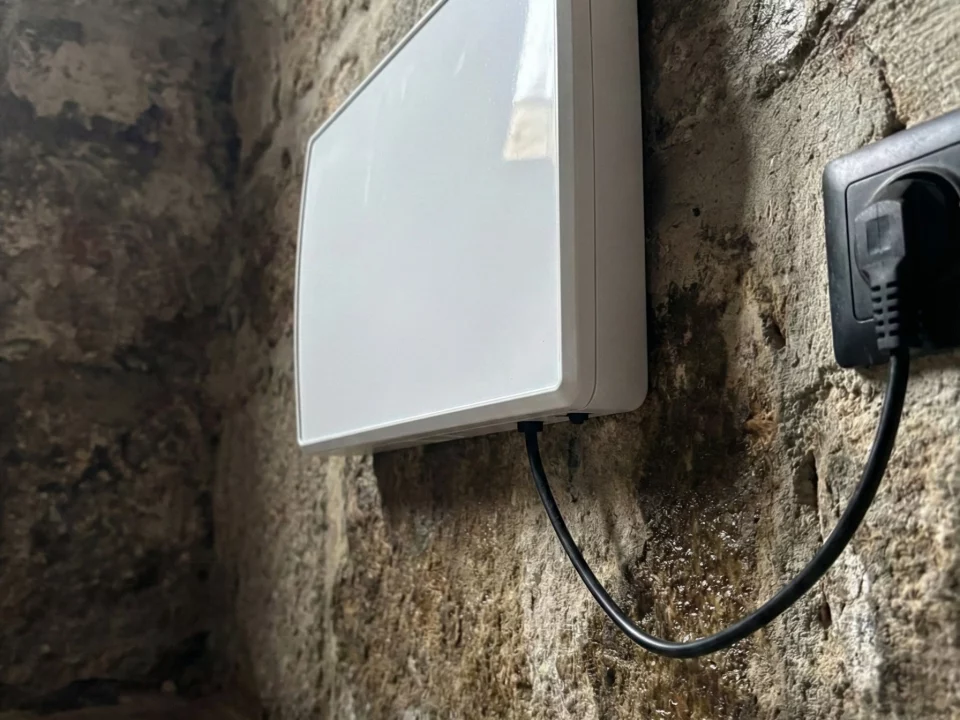
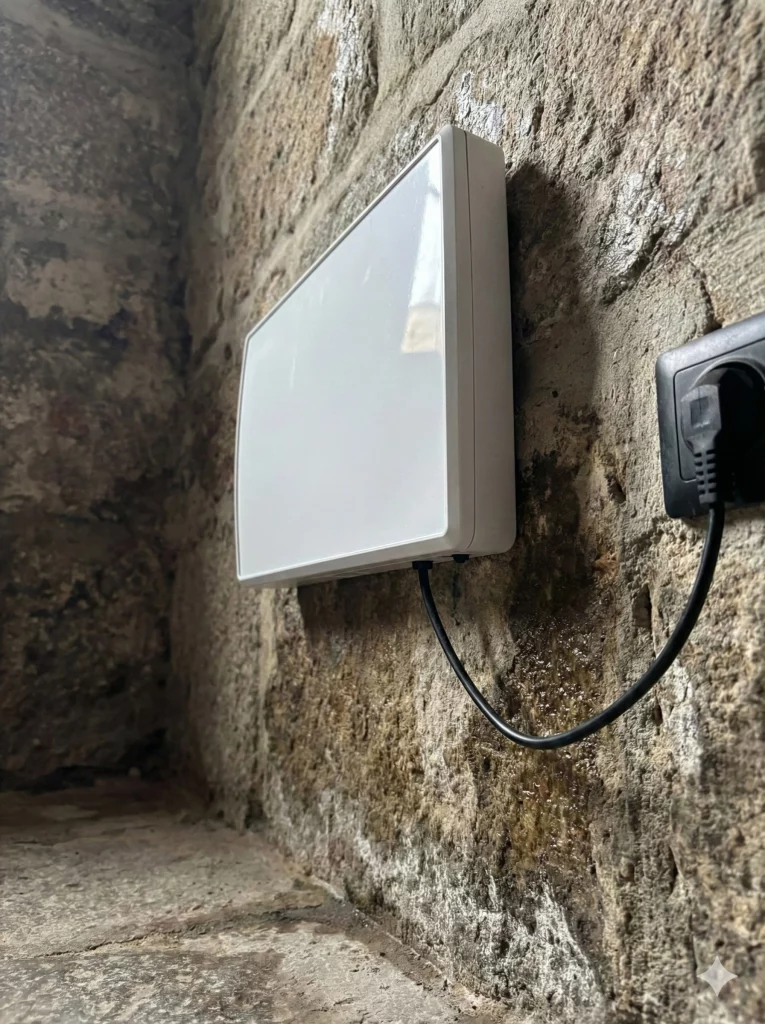
On a shared wall the advantage stands out. No drilling, no sawing, no product introduced into masonry you do not own alone. And the unit lifts off without leaving a trace.
Where to fit the unit on a shared wall
Choose the worst affected stretch and work at floor level. You need a flat surface and direct contact with the masonry, never dry lining.
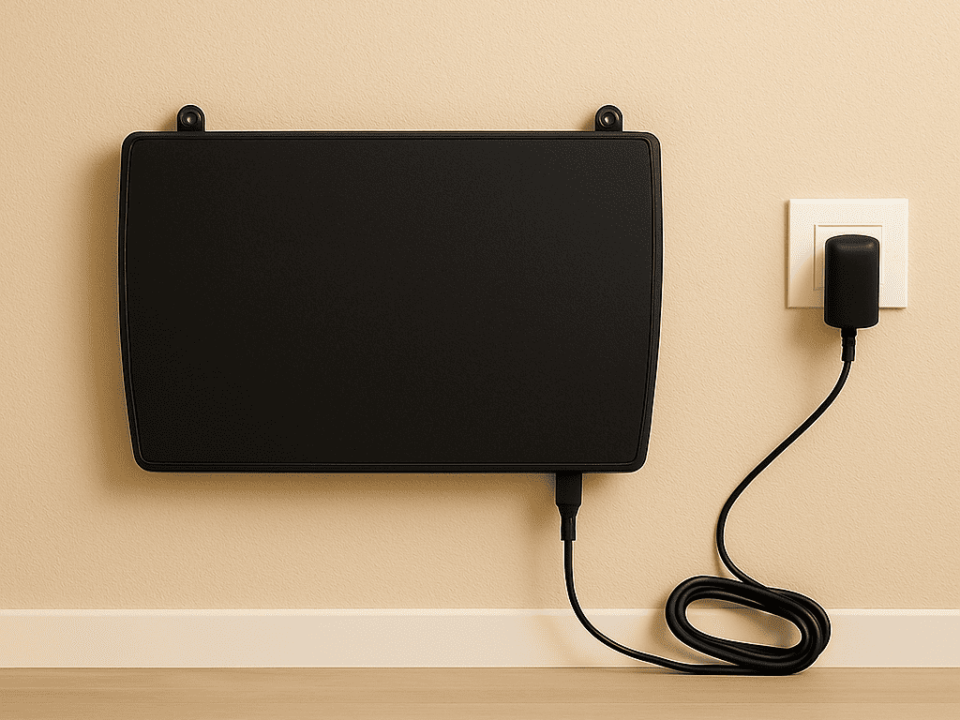
The ATE range works electromagnetically and needs an earthed socket, for roughly €15 of electricity a year. The ATG range needs no supply, although we only turn to it where fitting an ATE proves impossible.
Coverage depends on the model. The ATE LC15 reaches 7.5 metres around it, the ATE LC30 reaches 15 metres, and the ATE Max reaches 30 metres. On a long party wall, measure the real distance before choosing.
One limit deserves repeating. These units treat rising damp. By contrast, they treat neither water penetration, nor flooding, nor surface mould.
Steps that speed up drying
Strip sealed finishes low down: cement render, impermeable paint, bonded tiling. Indeed, they stop water evaporating.
Remove dry lining across the treated area, so air can move against the masonry again.
Pull furniture away from the party wall. A windowless wall already breathes poorly, so do not smother it further.
Finally, fix outside water sources. They feed the soil continuously and reduce the benefit of any treatment.
How long before results
Saturated masonry releases its water slowly. Patience therefore forms part of the process.
When you follow our installation guidance, you generally see improvement between 18 and 24 months. Useful signs arrive earlier. The upper edge stops climbing. Moreover, the render settles and no new deposits form.
One visual effect misleads people. As water evaporates, it leaves behind the salts it carried. A wall that is improving therefore looks temporarily whiter.
Frequently asked questions
Can a damp party wall come from next door?
Yes, particularly with a leak or penetrating damp on their side. By contrast, rising damp affects the whole wall, therefore both homes.
Do I need my neighbour’s agreement to treat it?
The unit fixes to your face of the wall, with no drilling at all. Even so, telling your neighbour remains the best way to avoid a misunderstanding.
Does the unit work on the other side too?
It acts on water held within the thickness of the wall. Since the wall is single, both faces dry together.
What if the damp comes from a leak next door?
No rising damp treatment will change anything. The leak must be repaired first, then the wall can dry.
How can I confirm the source?
Send us photographs of both faces where possible. We then point you in the right direction, free of charge and with no site visit.
In short
A damp party wall needs a diagnosis first, because the wall is shared and water may come from either side. Check the shape of the mark, the neighbouring face, the seasonal rhythm and the base of the wall outside.
If water rises from the ground, favour a solution that does not drill into shared masonry. To find the right model, visit the Humidistop shop, or write to us through the contact form.